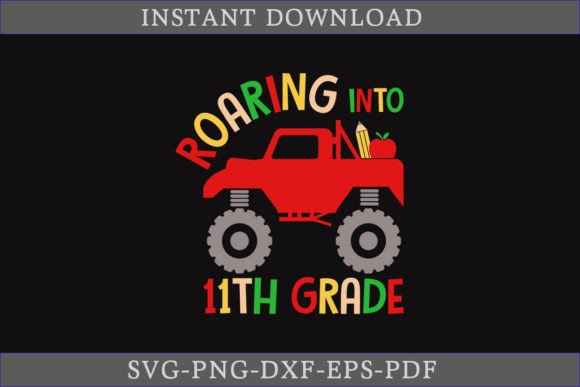
Roaring into 11th Grade SVG Cut File: A Versatile, Production-Ready Design for Back-to-School Creativity
Back-to-school season isn’t just about notebooks and backpacks—it’s a cultural moment where identity, growth, and self-expression converge. For students entering their junior year, the transition into 11th grade carries heightened significance: it’s the bridge between foundational learning and college readiness, between adolescence and emerging adulthood. That’s why design assets like the Roaring into 11th Grade SVG Cut File resonate beyond aesthetics—they serve as tangible markers of achievement, community belonging, and personal narrative. This isn’t merely decorative clip art; it’s a production-grade vector resource engineered for real-world application across physical and digital mediums.
Why Vector Precision Matters in Educational and Creative Contexts
At its core, the Roaring into 11th Grade SVG Cut File is built on vector geometry—not pixels. Each element is composed of mathematical paths, anchor points, and Bezier curves. This architecture enables infinite scalability without loss of fidelity. Whether printed at 2 inches on a lapel pin or enlarged to 36 inches for a classroom banner, the design retains crisp edges and proportional integrity. Unlike raster-based graphics (e.g., JPEGs or basic PNGs), vectors eliminate pixelation, moiré patterns, and anti-aliasing artifacts—critical considerations when outputting to vinyl cutters, screen-printed apparel, or laser-engraved wood signs.
This precision directly supports educational workflows. Teachers preparing classroom décor can scale the design to fit standard bulletin board dimensions (e.g., 24" × 36") without reworking layouts. Youth program coordinators printing event T-shirts for a high school leadership summit can adjust stroke weights and spacing to ensure legibility on both youth small and adult XXL garments. And for students themselves—many now using Canva, Cricut Design Space, or Adobe Illustrator—the vector foundation means they’re not locked into preset sizes or forced to rely on low-resolution imports.
Multi-Format Accessibility Meets Real-World Tool Compatibility
The package delivers one ZIP archive containing five distinct file types: SVG, DXF, EPS, PNG, and PDF. Each serves a specific functional role:
- SVG: The web-native standard—ideal for digital use in HTML pages, LMS dashboards (like Canvas or Google Classroom), or interactive presentations. It loads quickly, scales responsively, and supports CSS-based color manipulation.
- DXF: The lingua franca of CNC routers, laser cutters, and industrial plotters. Silhouette Studio users benefit from native DXF support, while hobbyists with Glowforge or xTool machines find it essential for precise material registration.
- EPS: A legacy but still widely supported format for professional print shops and commercial embroidery digitizers. Its compatibility with Adobe Illustrator versions back to CS6 makes it indispensable for collaborative environments where software versions vary.
- PNG: A high-resolution raster fallback—useful for social media announcements, email newsletters, or PowerPoint slides where vector embedding isn’t feasible. The included PNG is transparent-background and 300 DPI, suitable for sharp on-screen display.
- PDF: A universally viewable, print-ready document. Educators can open it in free readers like Preview or Adobe Acrobat, annotate it, or send it directly to office printers without font substitution risks.
This breadth eliminates format-related friction. A small business owner launching a “Grade 11 Spirit Pack” doesn’t need to convert files manually or pay for third-party services. A homeschool co-op leader prepping personalized graduation milestone kits can open the SVG in Inkscape (free and open-source) and recolor each student’s name in under two minutes.
Color Flexibility and Editability: Beyond Static Graphics
One standout feature of the Roaring into 11th Grade SVG Cut File is its intentional layering and grouping structure. Colors aren’t baked in via raster overlays—they’re assigned to individual vector objects using fill attributes. This means users can change hues globally or selectively: swap the lion’s mane from gold to navy for a school-color variant, shift the “11th” numerals to match a mascot’s accent shade, or desaturate background elements for monochrome heat-transfer vinyl.
Because it’s constructed from 100 discrete vector shapes—not merged compound paths—editing remains intuitive. In Illustrator, users can select components by clicking or using the Layers panel. In Cricut Design Space, the ungrouped nature allows for precise contour cutting, weld adjustments, or slice operations without unintended fragmentation. Even beginners benefit: renaming layers (“Main Text,” “Icon,” “Border”) provides immediate visual context during customization—no reverse-engineering required.
Practical Applications Across Diverse User Groups
The utility of this design extends far beyond student T-shirts. Its adaptability reveals itself across sectors:
Educators and Administrators
School counselors use the design on laminated “Junior Year Roadmap” handouts, embedding QR codes linking to SAT prep resources or college visit calendars. AP Biology teachers print it onto reusable lab coat patches for student lab teams. District communications offices integrate the vector into official press releases announcing academic award recipients—ensuring brand consistency across digital and print channels.
Creative Entrepreneurs
Small-batch apparel sellers on Etsy or Shopify leverage the multi-format bundle to offer custom options: “Add your school name,” “Choose vinyl color,” or “Include graduation year.” Because the base file is editable, they avoid per-customer design fees—streamlining fulfillment while maintaining personalization. Similarly, sticker shop owners create layered die-cut stickers (e.g., matte finish for laptops, holographic for water bottles) by exporting separate SVG layers for each material profile.
Students and Families
Juniors themselves use the file to craft personalized study journals, decorate locker organizers, or design Instagram Story templates celebrating milestones (“First AP Exam Done!”). Parents incorporate it into digital “Grade 11 Countdown” calendars shared via WhatsApp or family cloud storage—PNG versions render reliably across Android and iOS devices without app dependencies.
Community Organizations
Youth development nonprofits designing summer bridge programs for rising 11th graders embed the graphic into participant workbooks, workshop banners, and scholarship application portals. Its clean, confident aesthetic reinforces themes of capability and forward motion—aligning visual language with program goals.
Implementation Considerations for Optimal Results
While the Roaring into 11th Grade SVG Cut File is production-ready, thoughtful implementation enhances outcomes:
- Material testing matters. Before cutting 50 vinyl decals, run a test on scrap material—especially with intricate elements like paw prints or serif typography. Adjust blade depth and pressure based on substrate thickness (e.g., permanent vs. removable vinyl).
- Font licensing is handled. All text elements are converted to outlines, eliminating external font dependencies. Users won’t encounter missing-font warnings or layout shifts when opening files across devices.
- Export settings affect usability. When saving modified versions, retain SVG 1.1 compliance for widest Cricut/Silhouette compatibility. Avoid SVGZ compression unless targeting modern web apps exclusively.
- Respect intellectual property boundaries. The license permits unlimited personal and commercial use—but prohibits reselling the unaltered file as a standalone digital product or claiming authorship of the original design.
These nuances reflect deeper principles of responsible digital craftsmanship: anticipating user constraints, honoring technical ecosystems, and designing for longevity—not just novelty.
Connecting Design to Developmental Milestones
What distinguishes this asset from generic “back to school” graphics is its specificity. “Roaring into 11th Grade” evokes agency, voice, and emergence—not passive attendance. The lion motif (a common symbol of courage and leadership) pairs intentionally with typographic weight and upward-motion composition. It avoids infantilizing tropes (cartoonish animals, excessive glitter) while remaining accessible and warm. That balance reflects an understanding of adolescent psychology: juniors respond to recognition of their growing autonomy, not oversimplified cheerleading.
In practice, that translates to higher engagement. Students are more likely to wear apparel featuring this design because it affirms their current identity—not a nostalgic version of childhood. Educators report stronger buy-in when visual materials mirror the maturity level of curriculum expectations. Even in data visualization contexts, designers repurpose its color palette and iconography to represent academic progress metrics—turning abstract benchmarks into relatable visual narratives.
Ultimately, the Roaring into 11th Grade SVG Cut File succeeds not because it’s technically proficient—though it is—but because it meets users where they are: balancing creative flexibility with structural reliability, expressive potential with practical execution, and symbolic resonance with measurable utility. It’s a quiet enabler of bigger things—confidence built stitch by stitch, recognition earned inch by inch, and identity affirmed, again and again, in every cut, print, and pixel.