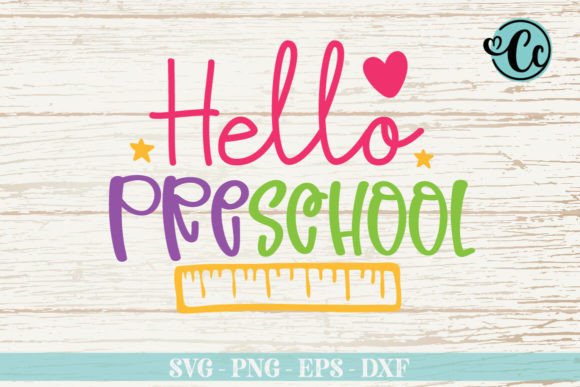
Hello Preschool, School T-shirt SVG: A Strategic Asset for Educators and Creative Entrepreneurs
SVG files like the Hello Preschool, School T-shirt SVG are more than decorative assets—they’re flexible, scalable tools that support intentionality in communication, branding, and operational execution. When you choose a layered, high-resolution vector file—complete with SVG, PNG (300 DPI), and EPS formats—you’re not just acquiring clipart. You’re investing in a reusable, editable foundation that adapts to evolving needs: from classroom celebrations to small-business merch lines, teacher appreciation campaigns, or parent engagement initiatives.
Why This File Format Matters More Than You Think
A true Hello Preschool, School T-shirt SVG is layered and editable—not flattened or raster-only. That distinction changes what you can do. Layered vectors let you isolate text, icons, or background elements; adjust colors to match school branding; resize without pixelation; or recombine components across multiple designs. For educators building a 100 Days of School celebration kit, that means one base file can generate t-shirts, classroom banners, digital newsletters, and printable reward stickers—all consistently styled, all on-brand.
For small business owners selling custom apparel or educational printables, this flexibility translates directly into margin preservation and speed-to-market. Instead of commissioning new artwork for every variation—“100th Day of School Shirt PNG” for kindergarteners, “Back to School Shirt” for staff, “Gift for Teacher” versions with alternate fonts—you start from a single, well-structured source. That reduces revision cycles, eliminates licensing ambiguity, and supports rapid A/B testing of messaging or layout.
Strategic Use Cases Beyond the Obvious
Most users reach for the Hello Preschool, School T-shirt SVG to make t-shirts. But its highest-value applications often lie elsewhere:
- Classroom culture systems: Print the design on laminated name tags, behavior charts, or reading milestone trackers—then update colors or labels digitally as student needs shift.
- Parent communication consistency: Use the same iconography and typography across welcome packets, event flyers, and digital announcements. Visual continuity builds trust and reduces cognitive load for families navigating early education transitions.
- Teacher professional development kits: Embed the vector into editable slide decks or workshop handouts. Participants can personalize examples—changing grade level, school name, or theme—making training more relevant and actionable.
- Local vendor partnerships: Provide the EPS and SVG files to screen printers, mug suppliers, or sign shops. Clear, production-ready assets reduce miscommunication, minimize proofing rounds, and ensure color accuracy across physical products.
When Context Determines Value—Not Just File Type
Having a Hello Preschool, School T-shirt SVG doesn’t guarantee impact. Its usefulness depends entirely on alignment with your goals and audience. A preschool director launching a new enrollment campaign may use it to reinforce warmth and readiness—pairing “Hello Preschool” with soft pastel tones and rounded fonts. A STEM-focused charter school, however, might strip back the script, emphasize clean geometry in the “100th Day of School Celebration SVG,” and integrate counting icons or binary motifs—transforming the same base file into a signal of academic identity.
This is where intentionality separates tactical execution from strategic leverage. Before opening the file, ask:
- What specific outcome am I trying to support? (e.g., increase parent sign-ups by 15%, improve student recognition during milestone events, strengthen brand recall among local families)
- Who interprets this visual—and what assumptions might they bring? (e.g., teachers see workload implications; parents see tone and values; vendors see technical constraints)
- Where will this appear—and how must it adapt? (e.g., embroidered on a polo vs. printed on a vinyl sticker vs. animated in a social media story)
Without those questions, even the highest-resolution Hello Preschool, School T-shirt SVG risks becoming visual noise—repetitive, disconnected, or misaligned with deeper objectives.
Risks of Using Without Purpose or Planning
Unplanned usage carries quiet but real costs. Reusing the same “100 Day Shirt PNG” across multiple years without refreshing context can unintentionally signal stagnation—especially if student demographics, curriculum priorities, or community expectations have shifted. Over-reliance on generic celebratory graphics (“100th Day of School Celebration SVG”) without tying them to authentic learning milestones may dilute instructional meaning. Students notice when ritual replaces rigor.
Similarly, entrepreneurs who treat the file as a plug-and-play product—uploading it unchanged to print-on-demand platforms—miss opportunities to differentiate. Competitors offer near-identical “Back to School Shirt” designs. Your edge comes not from owning the file, but from how thoughtfully you reinterpret it: adding local landmarks, translating slogans into dual-language formats, or embedding QR codes linking to classroom blogs or supply lists.
How to Customize With Discipline—Not Just Decoration
Editability is only valuable if guided by clarity. Start customization with constraints—not freedom:
- Color restraint: Limit your palette to three core colors max. Use the SVG layers to swap fills—not add gradients or shadows that won’t translate cleanly to embroidery or heat transfer.
- Type hierarchy: If modifying text, preserve legibility at 8-inch print width. Avoid ultra-thin fonts or tight kerning for t-shirt applications—what looks elegant on screen often vanishes on fabric.
- Scalability checks: Resize the vector to 24 inches wide and inspect anchor points and stroke weights. If details blur or paths distort, simplify before exporting—not after.
- Output discipline: Export PNGs at exact dimensions needed (e.g., 4000×5000 px for large-format prints; 1200×1600 px for web banners). Don’t rely on browser resizing—it degrades sharpness and confuses CMS uploads.
Long-Term Positioning: Building Equity, Not Just Assets
Treat the Hello Preschool, School T-shirt SVG as part of an evolving visual equity system—not a one-off download. Document your customizations: which colors you chose and why, where each variant was deployed, how audiences responded. Over time, this creates a lightweight brand guide rooted in evidence—not assumption.
That documentation also enables delegation. A new assistant teacher can update a “Student Shirt” template using approved palettes and spacing rules. A marketing intern can generate social posts from the same source file—without needing design training. That scalability compounds value: the file becomes infrastructure, not decoration.
Final Consideration: What You *Don’t* Do With It Matters Too
Resist the urge to over-deploy. A “Hello Preschool” graphic on every handout, banner, email header, and tumbler doesn’t reinforce identity—it blurs it. Strategic repetition means using the same visual language in moments that matter: first-day welcome kits, transition letters to kindergarten, end-of-year reflections. Random repetition just trains people to tune out.
Also resist treating the included files as static endpoints. The EPS and layered SVG exist to be modified—not merely opened and printed. If your goal is differentiation, then editing isn’t optional. It’s the point.
The Hello Preschool, School T-shirt SVG, the 100 Days of School Shirt SVG, the 100th Day of School Celebration SVG—these aren’t isolated products. They’re entry points. Their real utility emerges only when paired with clear intent, contextual awareness, and disciplined execution. Choose them not because they’re available, but because they serve something precise you’re trying to build, communicate, or sustain.