Book Flowers Tumbler Mug Wrap, Clipart: A Strategic Asset for Thoughtful Creative Execution
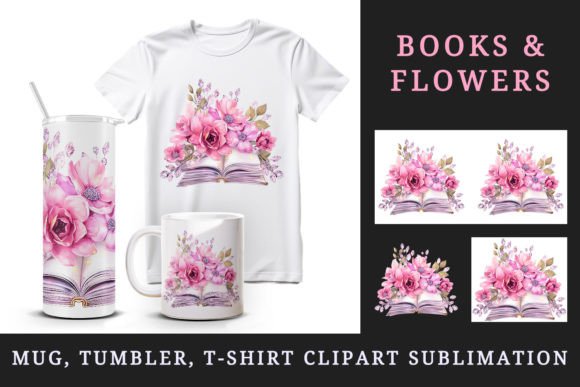
High-resolution, purpose-built design assets like the Book Flowers Tumbler Mug Wrap, Clipart aren’t just decorative—they’re operational tools. When you’re developing branded merchandise, launching a back-to-school campaign, or building a cohesive visual identity for an educational product line, this specific asset delivers precision: 300 dpi PNG files with transparent backgrounds, sized intentionally for real-world production—3600 px for 20 oz skinny tumblers, 2790x2460 px for standard mugs, and 2925x1425 px for straight-wrap applications. That level of technical readiness means less time troubleshooting file scaling or transparency issues—and more time focusing on what matters: audience resonance, brand alignment, and measurable outcomes.
Why This Design Fits Real-World Planning Cycles
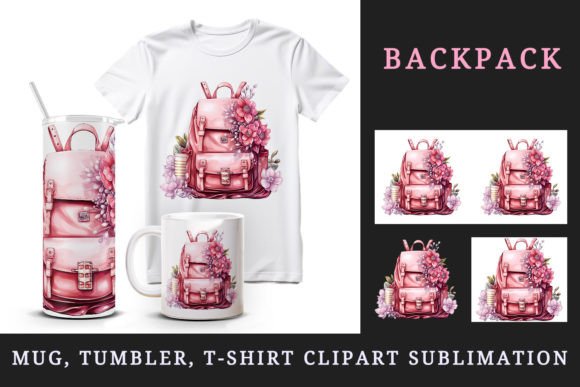
The Book Flowers Tumbler Mug Wrap, Clipart works because it bridges aesthetic intent with functional specificity. Its watercolor texture, soft pink florals, subtle sparkle, and reading-themed motifs (open books, gentle typography cues) speak directly to a demographic that values warmth, intelligence, and quiet confidence—not loud novelty. For educators designing classroom incentives, small business owners curating a “Back to School 2024” collection, or freelance designers building sublimation-ready bundles for Etsy or Creative Market, this isn’t generic clipart. It’s a pre-vetted visual shorthand for focus, growth, and approachable learning.
Consider how timing affects value: launching a tumbler line in late July aligns with supply chain lead times, teacher prep windows, and student anticipation cycles. Having a production-ready Book Flowers Tumbler Mug Wrap, Clipart eliminates bottlenecks in mockup creation, vendor handoff, or platform upload—especially when working with print-on-demand partners who require exact dimensions and clean alpha channels. That’s not convenience—it’s strategic leverage.
How Intentional Use Strengthens Brand Positioning
Brand consistency isn’t about repeating the same image everywhere. It’s about maintaining a coherent emotional temperature across touchpoints. The watercolor softness and delicate sparkle in this design signal care—not perfectionism. That distinction matters when positioning products for girls aged 8–14, their parents, or educators seeking inclusive, non-stereotypical “girl-coded” visuals. Using the Book Flowers Tumbler Mug Wrap, Clipart alongside complementary assets—say, matching notebook covers or lesson plan headers—builds recognition without redundancy.
But intentionality requires context. If your brand voice is bold, minimalist, or tech-forward, this design may dilute clarity unless deliberately contrasted (e.g., using it only for “creative break” sub-brands within a larger suite). Ask: Does this support the primary message—or does it soften it unintentionally? The same floral motif that feels nurturing in a literacy nonprofit’s merch might feel off-brand for a coding camp targeting middle schoolers. Alignment starts with goals—not aesthetics alone.
Practical Integration: Beyond the Obvious
Yes, the Book Flowers Tumbler Mug Wrap, Clipart fits seamlessly on 20 oz skinny tumblers and ceramic mugs—but its utility extends further. Because it’s delivered as layered, high-res PNGs with transparent backgrounds, it adapts well to:
- Sublimation-ready t-shirt designs: Isolate the floral cluster or book icon for pocket prints; scale the full wrap horizontally for all-over tees.
- Digital course materials: Use cropped elements as section dividers in PDF workbooks or Canva-based slide decks for student-facing content.
- Social media templates: Drop the 3600 px version into mockup generators for Instagram carousels promoting “study essentials” bundles.
- Educational printables: Combine with editable text layers to create reading challenge trackers or library reward certificates.
This versatility isn’t accidental. The 300 dpi resolution ensures sharp output whether printed at 4x6 inches or scaled to fill a trade-show banner background. But versatility demands discipline: avoid stretching the design beyond its native proportions, and never re-rasterize from a compressed preview. Preserve the integrity of the original files—rename versions clearly (e.g., “book-flowers-tumbler-3600px-v2”) to prevent version drift during team collaboration.
Risks of Context-Free Deployment
Even high-quality assets can weaken impact when decoupled from strategy. Deploying the Book Flowers Tumbler Mug Wrap, Clipart without considering audience perception risks misalignment. For example, overusing sparkle and pastel tones across all customer communications may unintentionally signal “for beginners only”—a problem if your curriculum targets advanced readers or competitive academic programs. Similarly, applying it to packaging for boys’ reading kits without thoughtful adaptation could reinforce outdated gender binaries rather than inclusivity.
Another risk lies in production assumptions. While the PNG dimensions match common tumbler and mug specs, actual print results depend on substrate quality, sublimation press calibration, and ink formulation. Always run physical test prints before bulk orders—even with perfect files. A pixel-perfect digital file doesn’t guarantee color fidelity on matte ceramic or metallic-coated stainless steel. Treat the Book Flowers Tumbler Mug Wrap, Clipart as a starting point, not an endpoint.
Decision-Making Framework for Long-Term Value
Before licensing or integrating this asset, apply a simple filter:
- Goal Check: Does this directly support a defined objective—e.g., increasing repeat purchases among teacher customers, differentiating from competitors in the $25–$35 tumbler segment, or reinforcing a “joyful learning” brand pillar?
- Audience Fit: Have you validated that pink florals + sparkle resonate with your actual buyers—not just your internal preferences? Review past bestsellers, social comments, or survey data.
- Production Readiness: Do your vendors accept these exact dimensions and file types? Are your designers trained to maintain transparency integrity when adding text overlays or adjusting hue/saturation?
- Extension Potential: Can this design anchor a family of related assets—or will it sit in isolation? If you’re investing in custom photography, consider shooting lifestyle images that feature the tumbler alongside books, notebooks, and natural light to reinforce narrative cohesion.
This isn’t about rigid rules. It’s about treating creative assets as infrastructure—measured by durability, adaptability, and contribution to outcomes—not just visual appeal.
Strategic Next Steps
If you’ve confirmed fit, start small: order one tumbler and one mug using the Book Flowers Tumbler Mug Wrap, Clipart, photograph them in authentic settings (a sunlit desk, a backpack corner), and test messaging with a micro-audience. Track engagement—not just likes, but saves, shares, and follow-up questions (“Where’d you get that?”). Let real behavior—not assumptions—guide scaling.
For teams managing multiple product lines, treat this asset as part of a living style guide. Document usage rules: recommended font pairings, minimum clear space around the floral cluster, acceptable color adjustments (e.g., “hue shift ±10° only”), and prohibited contexts (e.g., “not for use on assessment materials”). Clarity here prevents drift and preserves equity in how your audience experiences your brand over time.
Ultimately, the Book Flowers Tumbler Mug Wrap, Clipart earns its place not because it’s charming—but because it enables clarity, accelerates execution, and supports decisions rooted in audience understanding—not trend-chasing. When used with purpose, it becomes less of a “design” and more of a quietly effective tool in your operational toolkit.