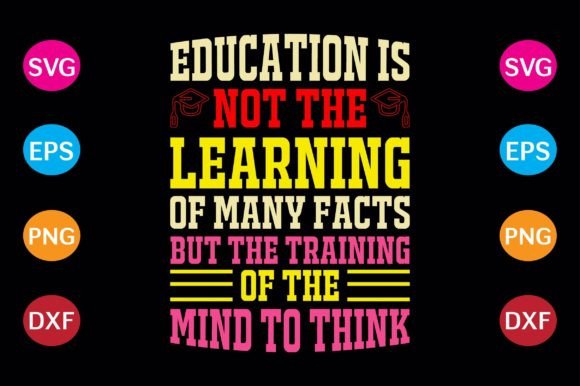
Education Is Not the Learning of Many Facts But the Training of the Mind to Think
“Education is not the learning of many facts but the training of the mind to think.” This powerful quote—often attributed to Albert Einstein—cuts through the noise of standardized testing, rote memorization, and credential-chasing. It reminds us that true education isn’t about how much you can recall on a Friday quiz—it’s about how thoughtfully you engage with ideas, solve unfamiliar problems, and adapt when the world changes. For adults returning to school, launching a side hustle, or supporting a child’s learning journey, this distinction isn’t philosophical—it’s practical. And it’s why a simple back-to-school T-shirt design bearing this message does more than spark conversation: it affirms a values-driven approach to lifelong learning.
Why This Mindset Matters Right Now
Adult learners face unique challenges: time scarcity, imposter syndrome, competing responsibilities, and outdated assumptions about what “counts” as learning. Many return to school expecting to absorb information—dates, formulas, definitions—and are surprised (and frustrated) when success hinges instead on analysis, synthesis, and self-directed inquiry. That disconnect is where Education is not the learning of many facts but becomes an anchor. It reframes struggle—not as failure, but as evidence of cognitive growth. It validates asking “why?” over rushing to “what’s the answer?” And it supports educators, parents, and self-learners in designing experiences rooted in curiosity, not compliance.
How This Principle Translates into Real-Life Learning
Consider three common scenarios:
- A working professional enrolling in an online degree program: Instead of highlighting every textbook chapter covered, they track how often they apply course concepts to real projects—like using behavioral economics principles to redesign a team workflow. That’s Education is not the learning of many facts but in action.
- A parent helping their teen prepare for college: Rather than drilling flashcards for SAT vocabulary, they co-read op-eds and discuss arguments, evidence, and bias. The goal isn’t memorizing definitions—it’s building judgment. That’s alignment with the core idea.
- An entrepreneur launching a micro-course on creative problem-solving: Their curriculum emphasizes reflection prompts, peer feedback loops, and iterative prototyping—not lecture slides full of theory. Learners walk away with sharper thinking habits—not just notes.
In each case, outcomes shift from “I know X” to “I can do Y”—and that shift starts with intentionality about what education *is*.
Your Back-to-School T-Shirt Design: More Than Apparel
This isn’t just another slogan tee. The Education is not the learning of many facts but design serves as both personal reminder and quiet invitation—to pause, reflect, and reclaim learning on human terms. Whether worn by a grad student in a seminar, a homeschooling parent at a co-op meeting, or a teacher starting the year, it signals shared values: depth over coverage, reasoning over recitation, growth over grades.
You’ll receive a digital download in a ZIP file containing ready-to-use, high-resolution files: SVG (ideal for Cricut and Silhouette cutting machines), DXF (for laser cutters and CAD software), EPS (scalable vector format for professional print shops), and PNG (300 DPI, transparent background—perfect for print-on-demand platforms or quick mockups). All files preserve crisp edges and clean typography at any size—so whether you’re printing one shirt or fifty, the message stays sharp and legible.
Practical Tips for Using This Design Meaningfully
Maximize its impact—not just as apparel, but as a catalyst:
- Start conversations: Wear it to orientation, faculty meetings, or parent-teacher conferences. Let it open space for rethinking assignments, grading, or classroom norms.
- Customize thoughtfully: Add your institution’s name, subject area (“…but the training of the mind to think in Chemistry”), or a small icon (a lightbulb, open book, or brain outline) to ground the idea in your context—without diluting its clarity.
- Pair with action: Use the shirt as a springboard—for example, host a “Thinking Over Facts” discussion group, redesign one assignment around process rather than product, or share a weekly “question that changed my perspective” with your team.
Different Needs, Same Core Idea
How you engage with Education is not the learning of many facts but depends on your role—but the principle remains flexible and scalable:
- For students: It’s permission to prioritize understanding over speed, to ask for clarification without shame, and to value revision as intellectual refinement—not correction.
- For instructors: It’s a lens for evaluating assessments: Does this prompt reward memory—or reasoning? Can learners demonstrate insight without perfect recall?
- For designers and creators: It’s guidance for crafting resources—like this T-shirt—that don’t just look good, but invite reflection, align with pedagogical integrity, and support real-world application.
No two learners follow the same path—but when the destination is thoughtful, adaptable minds, the journey becomes more intentional, humane, and effective.
Final Thought: Choose Tools That Reflect Your Values
Back-to-school season often floods us with checklists: supplies, schedules, syllabi. But the most meaningful preparation happens before the first day—when we clarify what learning truly means to us. Choosing a T-shirt design rooted in Education is not the learning of many facts but is a small, tangible way to declare that commitment. It’s not about rejecting knowledge—it’s about insisting that knowledge serve wisdom. That facts fuel questions—not replace them. And that every learner, at every age, deserves opportunities to practice thinking—not just repeating.
Thanks for choosing a resource that honors both intellect and intention. Your ZIP file includes everything you need to bring this idea to life—clean, versatile, and ready for real use.