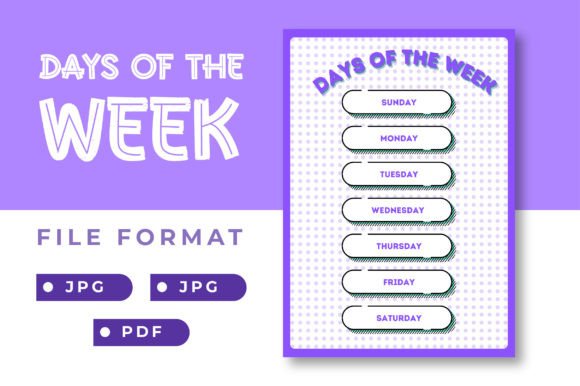
Days of the Week Poster Printable Poster
A Days of the Week Poster Printable Poster is a ready-to-use educational resource designed to support early literacy and time-concept development in young learners. It presents the seven days—Monday through Sunday—in a visually organized, consistent format. Unlike handwritten or improvised classroom charts, this printable comes pre-designed with intentional typography, color coding, and layout choices that align with early childhood learning principles. It is delivered digitally as a set of files: a PDF for high-fidelity printing, a JPG for quick sharing or digital display, and a PNG with transparent background for flexible integration into other materials.
People often seek a Days of the Week Poster Printable Poster when they need a reliable, low-prep tool to reinforce routine, sequencing, and calendar awareness. Teachers may look for classroom-ready visuals that complement morning meetings or daily schedules. Homeschooling caregivers might prefer it as part of a structured yet adaptable learning environment. Parents setting up a nursery or playroom sometimes choose such posters to introduce foundational concepts without pressure or formal instruction. The appeal lies not just in aesthetics but in functional design: clarity, repetition, and visual consistency—all known to support memory retention in preschool and kindergarten-aged children.
The primary benefit of this poster is its immediacy and adaptability. Because it’s delivered as a digital download, users avoid shipping delays, inventory constraints, or limited edition availability. Printing allows customization: size (e.g., A4 for individual desks, A3 or larger for wall mounting), paper type (matte, glossy, or laminated for durability), and placement (classroom wall, homeschool learning center, or child’s bedroom). The vibrant colors and kid-friendly fonts are intentionally selected to attract attention without causing visual fatigue—a balance supported by research on early visual processing. Additionally, having both JPG and PNG files means educators can embed the days into interactive whiteboard lessons or digital planners without losing quality.
However, there are practical tradeoffs to consider. As a static visual aid, the poster alone does not teach; it supports teaching. Its effectiveness depends on how it’s used—paired with verbal repetition, songs, movement-based activities, or discussion about “today,” “yesterday,” and “tomorrow.” Without active engagement, even the most vibrant design risks becoming background decor rather than a learning tool. Also, while the file formats offer flexibility, users must have access to a printer and basic software to open and manage PDFs or image files. Those without reliable printing options—or who prefer tactile, manipulative tools—may find value in supplemental resources like magnetic days, flip charts, or pocket charts instead.
Another consideration is developmental appropriateness. The poster assumes a baseline level of letter recognition and left-to-right reading directionality. For children still developing these skills, pairing the poster with oral routines (“What day is it today? Let’s point to it together”) or finger-tracing the words can bridge the gap. For multilingual households or classrooms, the standard English version may require additional scaffolding—such as bilingual labels or audio reinforcement—to ensure inclusive access.
This Days of the Week Poster Printable Poster tends to be a strong fit in several contexts. It works well in kindergarten and first-grade classrooms where visual anchors support daily routines and transitions. It’s equally useful in homeschool settings where parents curate focused, low-clutter learning spaces. Early intervention specialists or speech-language pathologists may incorporate it into sessions targeting sequencing language or temporal concepts. It also suits nurseries or pediatric waiting areas aiming to normalize educational exposure in relaxed environments.
Conversely, alternatives may be more appropriate in certain situations. For learners with visual processing differences, a high-contrast or simplified version—with fewer decorative elements and larger, bolder text—might improve readability. Children who benefit from kinesthetic learning may respond better to moveable pieces (e.g., Velcro-backed days) than a fixed poster. In digital-first learning environments—especially for remote or hybrid instruction—a well-designed interactive version (e.g., drag-and-drop calendar activity) could offer deeper engagement than a static image. And for older students reviewing time concepts, a more advanced version—including abbreviations, international date formats, or connections to months and seasons—would better match their cognitive level.
When deciding whether this resource meets your needs, reflect on three practical questions: First, what is your primary goal? If it’s reinforcing daily structure or building familiarity with day names in an age-appropriate way, the poster serves that purpose effectively. Second, what’s your implementation capacity? Do you have printing access and space to display it meaningfully? Third, how will you interact with it? A poster gains educational value when embedded in routine—not just hung, but pointed to, named, discussed, and connected to real-life events (“We go to the park on Saturday—that’s the day after Friday!”).
It’s also worth comparing similar resources before selecting. Some free online versions lack consistent font sizing or color contrast, which can hinder legibility. Others include extraneous clipart that distracts from the core content. This Days of the Week Poster Printable Poster distinguishes itself through balanced design: enough visual interest to hold attention, but sufficient simplicity to keep focus on the days themselves. Still, no single tool replaces responsive teaching—so consider how this fits within your broader strategy for teaching time concepts, not as a standalone solution.
In summary, the Days of the Week Poster Printable Poster is a practical, evidence-informed option for educators and caregivers seeking a durable, versatile, and developmentally grounded visual aid. Its strength lies in accessibility, design intentionality, and ease of integration—not novelty or complexity. Whether used in a bustling classroom, a quiet home corner, or a nurturing nursery space, its value emerges most clearly when paired with consistent, interactive use. Before downloading, assess your goals, context, and existing supports—and choose accordingly.